

Same traffic. Same spend. More customers
CRO is the discipline of finding out why visitors leave without buying, and fixing it, one measured change at a time. No redesign lottery, no opinions winning meetings: a baseline, a hypothesis, a test, and a decision made by real visitor behaviour. It’s the highest-leverage work in marketing because every point of conversion gained makes every naira of traffic, past, present, and future, work harder.
No obligation. No card required. Takes about 2 minutes.
Systems built for






You have a leaving problem
At a typical sub-5% conversion rate, more than 95 of every 100 visitors you paid to attract walk away. The usual response is to buy more visitors, pouring faster into the same leaking bucket, because the leak is invisible without measurement and unfixable without method.
<5%
Typical landing page conversion. On most pages, the overwhelming majority of hard-won traffic leaves without doing anything at all.
2×
What doubling conversion from 2% to 4% does to every future naira of ad spend, the same effect as halving your traffic costs, permanently, without touching a single campaign.
4 fears
Every Nigerian buyer checks before paying on a screen: Is this real? What will it really cost? Will it arrive? Can I reach a human? Unanswered fears are where conversions die.
Everything this engagement actually covers
The conversion audit
Where visitors actually leak, measured from real behaviour: analytics deep-dive, session recordings, form analytics, and speed tests on real Nigerian connections. The output is a ranked leak list priced by what each one costs you monthly, so the work starts where the money is.
Research into why, not just where
Numbers show where people leave; they don't say why. We add the why: heatmaps, scroll maps, exit points, and the step most CRO skips: actually asking customers what nearly stopped them buying. Fixes built on why outlast fixes built on guesses.
Hypothesis-driven testing
Every change starts as a written hypothesis, what we're changing, why, and the number that will judge it. Tested properly where traffic allows A/B testing, measured before-and-after where it doesn't, with the statistical caveats stated, not hidden.
Trust & friction engineering
The Nigerian-specific layer: recognisable payment infrastructure, delivery costs before checkout, WhatsApp reachability at peak-intent moments, forms cut to the fields that matter. The four buyer fears, systematically answered on-page.
Speed as a conversion feature
Page-weight budgets for mid-range Androids on mobile data, because a beautiful page that loads in eight seconds converts like a closed shop. Speed work is prioritised by the same leak-cost ranking as everything else.
The decision log
Every test recorded: hypothesis, result, decision, learning. The account compounds knowledge instead of repeating experiments, and you own the log, so the learning stays even if we part ways.
How the work actually runs, start to finish
1
Baseline & instrumentation check
CRO without trustworthy measurement is astrology, so the first step verifies tracking end-to-end, then records the starting numbers every later claim gets judged against.
2
The leak audit
Analytics, recordings, heatmaps, forms, speed, assembled into a ranked list of leaks, each priced by monthly cost. Sometimes the top leak is embarrassingly small; we’ll say so.
3
Hypothesis backlog, in writing
Every proposed fix written as a testable hypothesis with its expected impact and its judging metric, prioritised by leak cost, not by what’s most fun to redesign.
4
Test or measure, matched to your traffic
High-traffic pages get proper A/B tests. Lower-traffic pages get sequential before-and-after measurement with the uncertainty stated plainly, pretending small-sample tests are statistically rigorous is a lie we don’t tell.
5
Decide by the number, record the learning
Winners ship, losers revert, and both get logged, because a disproven hypothesis that saves you from a bad redesign is worth as much as a winner.
6
The 60-day conversion review
The formal checkpoint against the written goal: what moved, what didn’t, what the next cycle’s backlog becomes. Built into the engagement, not sold as an extra.
What most providers do, and what we do instead
THE USUAL APPROACH
- Redesigns judged by how they look in a boardroom
- "Best practices" copied from businesses unlike yours
- Changes shipped on opinion, results never checked
- Small-sample tests dressed up as statistical proof
- Learning lives in someone's head, leaves when they do
HOW WE RUN IT
- Leaks measured, ranked, and priced before anything changes
- Fixes built on why visitors leave, not guesses about it
- Every change judged by a pre-written number
- Honest statistics, including when traffic can't support a test
- A decision log you own, compounding what's been learned
How pricing works, honestly
CRO is scoped as cycles, quoted in writing after the audit: the audit itself (fixed price, standalone, and yours to act on with anyone, including without us), then ongoing optimisation cycles sized to how many pages and tests your traffic actually supports.
The honesty that matters here: if your traffic is too low for testing to be statistically meaningful, we’ll say so and recommend the cheaper path, usually fixing the obvious ranked leaks without the testing apparatus, which is a smaller engagement. Selling a full testing programme to a site whose traffic can’t support one is a common industry habit we don’t share.
HOW WE HOLD OURSELVES TO IT
Illustrative example of a written goal for a CRO engagement:
METRIC
Landing page conversion
BASELINE
2.1%
TARGET
4%+
DEADLINE
Day 90
If we miss it: the optimisation cycle runs again at our cost, new hypotheses, new tests, until the target holds.
Questions asked, and answered
CRO is scoped as cycles, quoted in writing after the audit: the audit itself (fixed price, standalone, and yours to act on with anyone, including without us), then ongoing optimisation cycles sized to how many pages and tests your traffic actually supports.
If your traffic is too low for testing to be statistically meaningful, we’ll say so and recommend the cheaper path, usually fixing the obvious ranked leaks without the testing apparatus, which is a smaller engagement. Selling a full testing programme to a site whose traffic can’t support one is a common industry habit we don’t share.
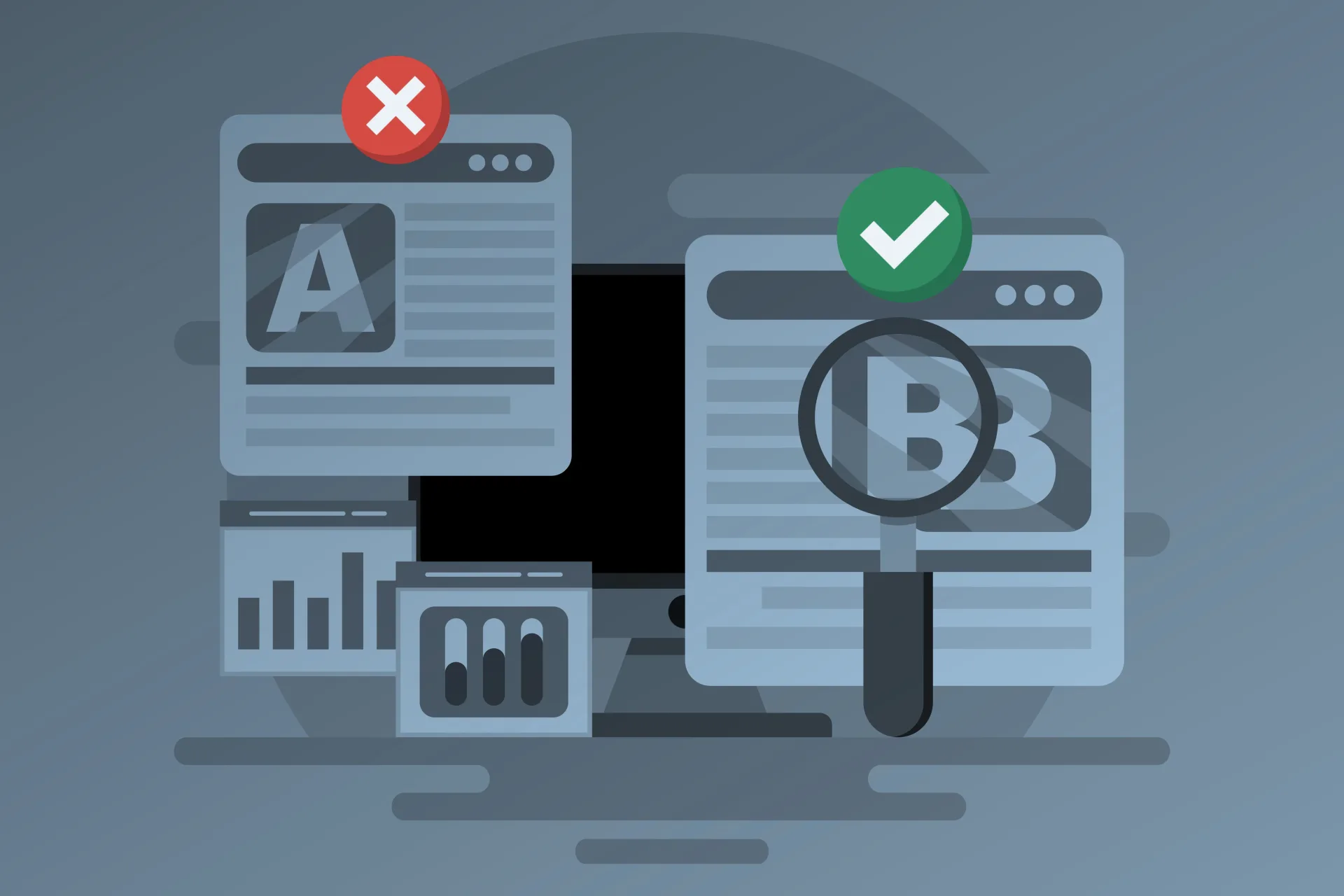
A redesign changes everything at once and hopes, when the number moves, nobody knows which change did it, and when it drops, nobody knows what to undo. CRO changes one measured thing at a time, so every improvement is attributable and every failure is reversible. It’s also usually far cheaper: the audit regularly finds that three targeted fixes outperform a full rebuild that would have cost ten times more.
For formal A/B testing, maybe not, and we’ll tell you honestly after the audit rather than pretend. But CRO isn’t only testing: the audit’s ranked leak list, the trust-and-friction fixes, and before-and-after measurement work at any traffic level. The method adjusts to your traffic; what never changes is that decisions get made by numbers, not opinions.
Faster than almost anything else in marketing: friction fixes (forms, speed, trust signals) often show within days of shipping; tested changes need a few weeks of real traffic for an honest read. The 60-day review is where the written goal gets formally judged, staged so you’re never waiting on faith.
It reverts, and the learning gets logged, that’s the system working, not failing. A disproven hypothesis that stops you shipping a conversion-killing redesign has real monetary value. What we won’t do is quietly bury losers and report only wins; the decision log records everything, and you own it.
Related reading from the Insights library



Find out what your current pages are actually converting
The 2-minute diagnostic shows which of your four walls is costing you most.
No obligation. No card required. Takes about 2 minutes.